



WHICH WATER TO USE FOR MY A CIF É MACHINE?
The water you use in your coffee machine can have significant consequences for the quality of your drink and the reliability of your device.
Depending on the region, the water made available at the tap does not have the same characteristics. Indeed, this water will turn out to be soft in Corsica, Auvergne and Brittany, and harder in the rest of France, sometimes with great local disparities.
Hard water or soft water, what does that mean?
Water hardness represents the quantity of calcium and magnesium soluble in water and is directly linked to the nature of the soils crossed.
The hardness of water is expressed in hydrotimetric titer (TH) or in French degrees (°f or °fH) , which corresponds to a concentration of 10 milligrams of calcium carbonate (CaCO3) per liter of water. Pay attention to the expression in German degrees of hardness which is equivalent to 10 milligrams of calcium oxide (CaO) per liter; which means that 1°fH = 1.78 Dh. The difference is significant...
The map below gives an overview of the water hardness on French territory. To get a more precise estimate, you can consult your water supplier, or check the value on your bill, because there are big local differences because catchments can be carried out in different ways depending on the municipality.
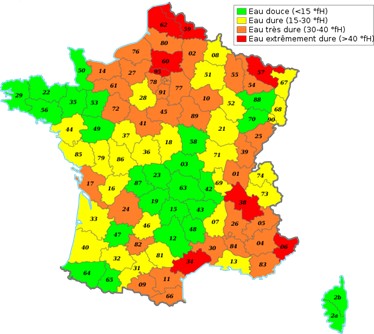
Meaning of colors:

The harder the water, the more it will encourage the precipitation of limestone (calcium carbonate). We can avoid the formation of scale by eliminating the calcium by using a softener, but the safest is monitor your coffee machine to carry out descaling as often as possible, to avoid damage to the device.
Can I use bottled or carboyed mineral water?
It's a legend to banish from your thoughts! Bottled mineral water in many cases causes havoc to your appliances, because its mineralization gives a very high risk of precipitation in the boiler, which will cause it to clog, intervention not covered under the guarantee.
Only some waters are suitable, they come from very fresh water sources from volcanic (Auvergne) or Granitic (Brittany) regions. In the example below, we cite waters which could be suitable in your coffee machine without risk of scaling because the calcium/magnesium mineralization does not exceed 30 to 40 mg/liter, beyond that the risk of scaling increases severely, the others should therefore be absolutely avoided.
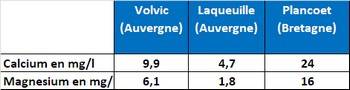
You must be careful to read the mineralization label on the bottle because certain brands, under the same name, use different sources from regions with strong disparities in terms of hardness.
Finally, let us be aware that some water bottles which have filters do not guarantee a reduction in water hardness. These are often filters intended to improve taste and remove certain undesirable substances (heavy metals, pesticides, chlorine, etc.).
In any case, descaling a coffee machine is the necessary operation to guarantee its longevity and performance, even if you use filters.
In addition, bottled water generates plastic waste which we can easily do without.
How do I know if my machine is scaling:
Several clues should attract your attention:
1: the water tank of your machine gradually becomes covered with a whitish film, this is a visible sign of the presence of scale in the water.
2: As the limestone aggregates on the resistance and the pipes and forms a thick layer which causes a reduction in the water flow, as a result the diffusion of the coffee takes longer, because the water is no longer able to flow properly.
3: Likewise, limestone forms an insulating layer on the resistance, and the heating time of your device becomes abnormally long.
4: coffee has a harsh, acidic taste, and the foam does not hold
5: water flows in drops from the hot water nozzle
6: The coffee is no longer flowing and the pump seems to be forcing
In conclusion
- Tap water is often the best for your machine
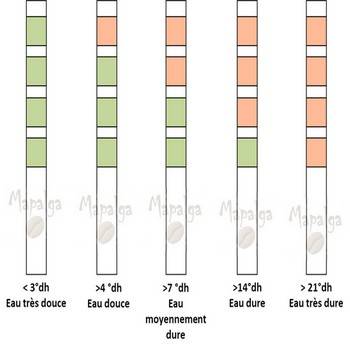
- Use a test strip to estimate water hardness. Be careful to use hardness strips and not acidity strips, which has nothing to do with it. see here those sold by MAPALGA:
Do not neglect descaling your machine as soon as the symbol for descaling appears and follow the instructions in the user manual.
Find our range of descalers here: